For a few hours, it appeared that Goa’s political maths book had been upended. It took one billboard and one post on X to do it. Suddenly, a normal Saturday at the beginning of a long holiday for Ganesh Chaturthi turned into a weekend of speculation and political intrigue.
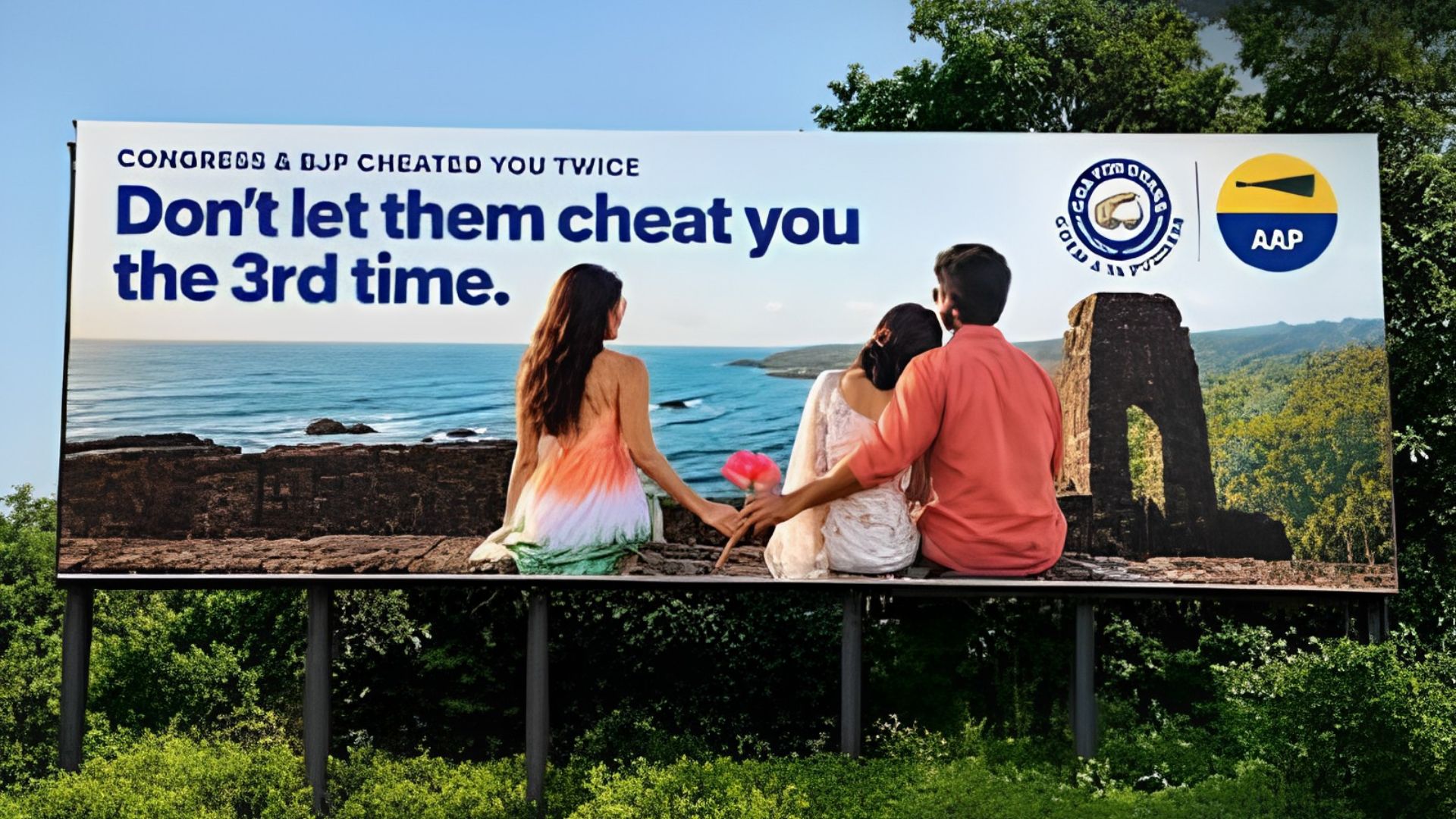
The billboard, with logos of the Aam Aadmi Party and Goa Forward Party, said ‘Congress and BJP cheated you twice don’t let them cheat you the 3rd time’. The post by AAP National Convenor Arvind Kejriwal said, ‘Coming to Goa today to make a big announcement’. If Kejriwal was attempting to be cryptic, the billboard said it all even before the announcement was made — the rumoured third front was turning into a reality.
The alliance brings on the same platform a regional party that espouses Goemkarponn and a national party that has a strong network and a populist agenda. In theory, it’s an amalgam of sentiment for Goa and welfare politics. It sounds like the perfect recipe for electoral victory.
But, politics is never that simple and elections can never be won so easily. By the time the big announcement was made by Kejriwal and GFP president Vijai Sardesai, some 24 hours after the billboard appeared, the novelty of it all had begun to wear off. And so, while it may not have turned out to be a damp squib, the intended fireworks didn’t quite light up the festive skies.
Who benefits from an alliance between AAP and GFP? Both parties have been in Goa for almost an equal length of time, but each taking different paths. In the past decade, AAP has been able to build a grassroots support system across the state, while GFP has remained rooted to its corner without sprouting elsewhere.
If one aim of the strategy is to present voters tired of the BJP and disillusioned by the Congress a viable alternative, the alliance will have to work extremely hard to coalesce the vote share of both parties. On the face of it, Goa’s changing demographics and high migration rate should make such a combination appealing to a wider section of the electorate. But, an amalgam of votes is not a natural corollary of such an alliance that does not necessarily have a common ideology.
In that respect, if another intention of the strategy is for GFP to benefit from the AAP network and for AAP to benefit from the GFP regional identity, then the odds of this materialising are currently low. In the months ahead, it may offer voters a common agenda, but there is little in common between the two parties. Merely the slogan ‘Goa First’ will not serve to attract voters.
On the other hand, there are plenty of issues on which this alliance will need to reach an understanding. Forming and announcing an alliance is just the beginning. Finding common ground, agreeing on agendas, allocating constituencies are very different issues, even problematic, at times.
In this respect, who will take the final decision? GFP is highly personality-driven, with Sardesai the face as well as the glue that holds the party together. With Kejriwal, AAP displays similar characteristics, but has a more decentralised structure and a local unit that has seen regular changes in party chiefs, with three of them now in the Congress.
Right now, the alliance is nothing, but a mathematical threat to the BJP and Congress in most constituencies, especially those where margins are low. But, there’s still time for all parties and formations to restructure strategies and change the equation. After all, politics is not about 2 + 2 = 4, but about x + y = z.
So, let’s wait for the Z factor that somehow always crops up to compound the already complex equation that is Goan politics.
The writer is a senior journalist, author and editor
Comments (0)
Please login to post a comment.
No comments yet. Be the first to comment!