
The current trend, especially with the politicians, is giving oneself an AI generated 1980s makeover — the apparel, hairstyle and look of that decade. Such pictures posted on social media have produced much interest, but what if instead of just pictures of individuals, Goa itself could be taken back to the decade of the eighties?
That’s a question that has also emerged, and AI has given its version of what Goa looked like or how it imagines Goa looked like in the 1980s. Those pictures are hardly reflective of what Goa was in those years and or how those of us, who lived in that decade, dressed. The 1980s were a very different period from what AI imagines it to be. I was still a student, stepping out of school to college and then university, but some things of that decade remain etched in memory.
Yes, Goa was still peaceful, neighbours knew each other, and neighbourhoods extended to an entire ward, there was so little traffic on the streets that you could play football on them, there were no high rises in the cities, there was mining but real estate was yet to boom and in the early years of the decade owning an Ambassador car was a status symbol. And then, Goa transformed with the 1980s coming to be the decade that defined how Goa would progress and change the course the Union Territory, and later the State, would take.
It began with a change in politics and governance. Congress came to power; a national party replaced a regional force and politics in Goa has never been the same. No regional party has come to power since then and governance escalated development.
The 1983, CHOG-M Retreat or Commonwealth Heads Of Government Meeting – Retreat boosted Goa’s tourism image, but also brought in development that might have otherwise taken a little, or perhaps even a lot, longer. Roads were asphalted, some like the Chogm road from Porvorim to Calangute for instance were constructed, telecom services were improved with Goa getting international dialing, luxury hotels were built and Goa was spruced up. A year later, the first charter flight landed and opened a new tourism market for Goa.
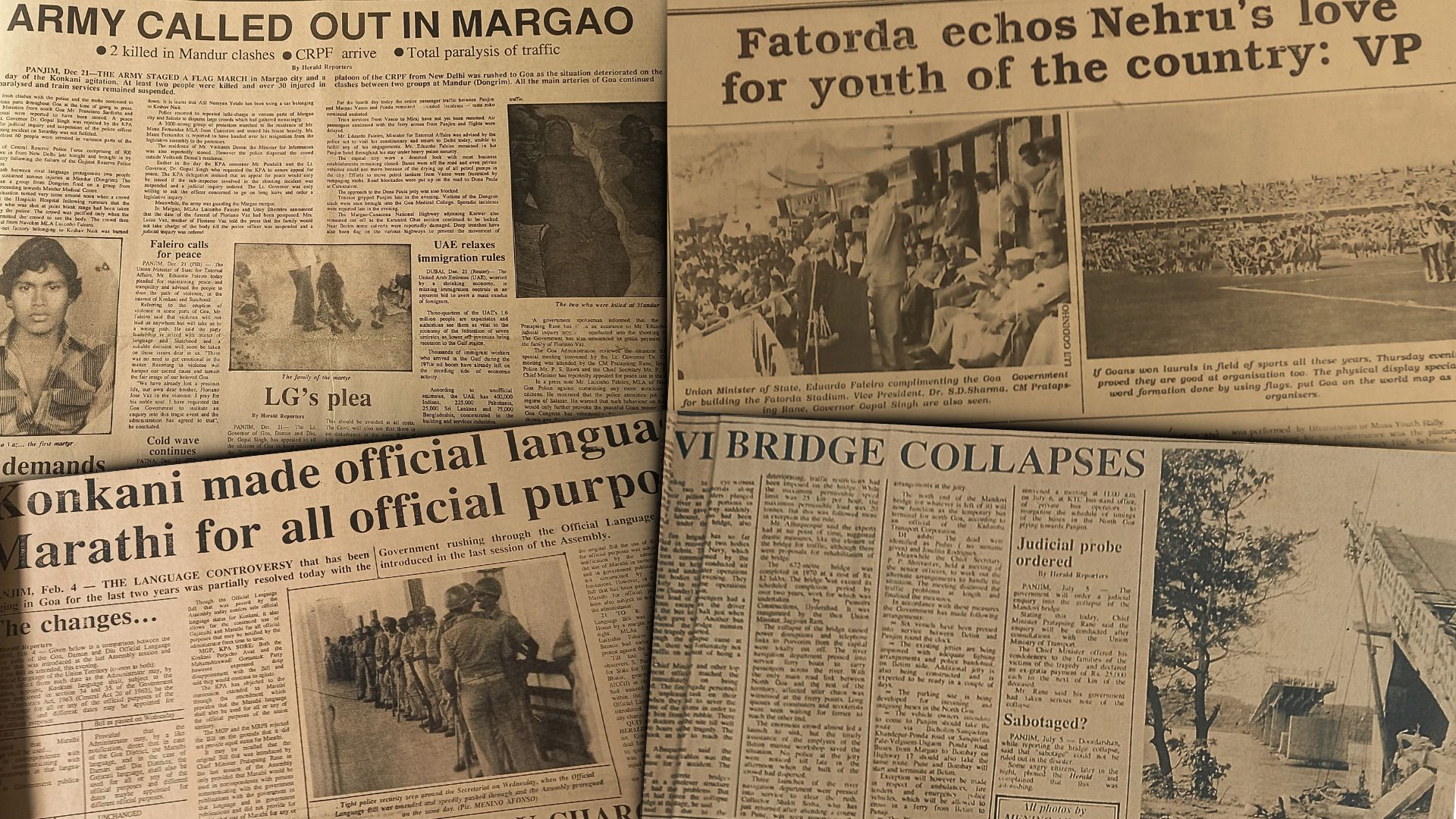
Goa then entered a long period of strife that lasted from July 1985 to February 1987 as the language agitation disrupted normal life, forced political equations to change, dominated the news, kept the law and order forces on their toes, but finally, Konkani limped home as the Official Language of Goa, setting the stage for statehood that followed just months later.
Development wise, roads continued to be built, water supply pipelines were extended, electricity lines were drawn to villages that had remained unelectrified, River Zuari got a bridge connecting North to South, but the bridge over the Mandovi collapsed, real estate began to show the first signs of becoming a major economic activity.
New colleges were started, Goa got a university, and I was one of the students of that first batch of Goa University degree holders, when it functioned from what would later be the Goa Medical College and Hospital. On the sports field, Goa won the Santosh Trophy for the first time and the Jawaharlal Nehru stadium was built in a record six months to host Goa’s first international tournament.
None of this can be captured by AI and its imagery. All this is only embedded in the minds of those who lived through that decade, and though a teenager in that entire decade, during which I wore my first pair of jeans, got my two-wheeler driver’s licence, and a degree making me eligible for employment, there are some things that human intelligence will score over artificial intelligence.
And no, however much some may yearn for it, Goa can never go back to the 1980s. Much has changed in the land and will continue to change in the years ahead. The past will only be a memory, a fond one at that.
The writer is a senior journalist, author and editor
Comments (0)
Please login to post a comment.
No comments yet. Be the first to comment!